Why the Same Amount of Fiber Feels Completely Different in the Morning and at Night
Quick Answer: Gut motility, gastric emptying, and gut microbial activity all follow a daily rhythm, running faster in the morning and slower in the evening. The same fiber load therefore moves through more quickly and ferments more gradually earlier in the day, and sits longer and ferments while you are lying down at night. For most people, front-loading fiber toward breakfast and lunch and keeping the evening portion moderate reduces bloating substantially without changing the daily total.
You have the same bowl of lentils twice in one week. Tuesday lunch: fine. Thursday, nine in the evening: not fine at all. Same food, same portion, same person. The variable was the clock.

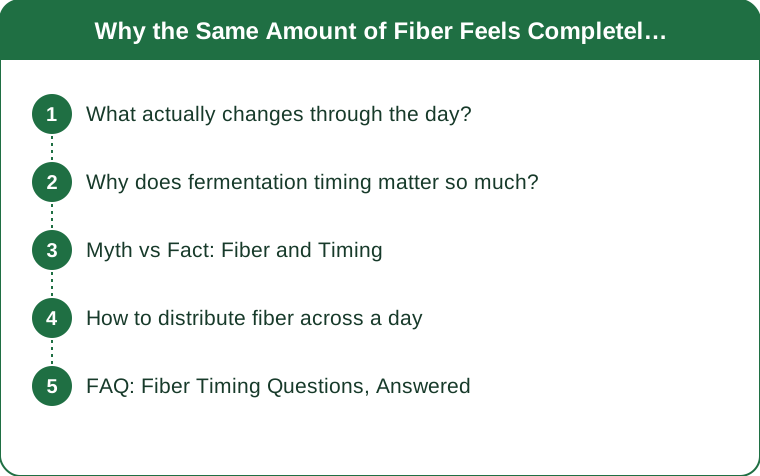
What actually changes through the day?
Four things, all on a circadian rhythm.
Gastric emptying is faster in the morning. Studies consistently find that identical meals leave the stomach more slowly in the evening than in the morning - by a meaningful margin, often 20 to 30 per cent. A meal eaten at 9pm sits in the stomach longer than the same meal at 9am.
Colonic motility has a strong daily pattern. Colonic contractions peak on waking and after meals, and drop substantially during sleep. The gastrocolic reflex - the reason many people need the bathroom shortly after breakfast - is strongest in the morning. Overnight, the colon is close to quiet.
The gut microbiome itself has a rhythm. The composition and metabolic activity of gut bacteria oscillate across a 24-hour cycle, with fermentation activity and gas production following a daily pattern. The same substrate arriving at different times meets a differently-behaving microbial population.
And your position changes. Upright during the day, horizontal at night. Gas that would move along and out while you are walking around distributes differently when you are lying down, and the sensation of bloating is closely tied to gas distribution rather than gas volume alone.
Put together: evening fiber arrives at a slower stomach, meets a slowing colon, ferments in a differently-active microbiome, and does so while you are horizontal for eight hours. That is four independent reasons for a different experience from an identical food.
Why does fermentation timing matter so much?
Because gas production is not instant - it happens hours after the meal.
Fermentable fiber reaches the colon roughly four to eight hours after eating, depending on the food and the individual. That is when the bacteria get to work and when gas production peaks.
Do the arithmetic on an evening meal. Fiber eaten at 8pm reaches peak fermentation somewhere between midnight and 4am - while you are asleep, lying flat, with colonic motility at its daily minimum. The gas is produced and it does not move.
The same fiber at 8am peaks between noon and 4pm - while you are upright, moving, drinking water, and with the colon actively contracting. The gas is produced and it moves along.
This is the single most useful thing to know about fiber timing and it explains why so many people conclude they are intolerant to beans, or lentils, or cruciferous vegetables, when what they are actually intolerant to is those foods at 9pm.
Fiber type modulates it. Highly fermentable fibers - inulin, fructans, galacto-oligosaccharides, resistant starch, the fiber in beans and onions and wheat - produce the most gas. Less fermentable fibers like cellulose in leafy greens and the fiber in most whole fruit produce comparatively little. Psyllium sits in the middle, gelling and adding bulk without heavy fermentation, which is why it tends to be better tolerated at any hour.
And sleep is affected in both directions. Some evidence suggests higher fiber intake is associated with better sleep quality overall, while a large fermentable load right before bed clearly disturbs it in people prone to bloating. The resolution is total daily fiber high, evening timing moderate.

Myth vs Fact: Fiber and Timing
Myth: Fiber timing does not matter, only the daily total. Fact: The daily total is what matters for the health outcomes - cholesterol, blood sugar, colorectal health, microbiome diversity. Timing does not change those. What timing changes is comfort, and comfort is what determines whether you stick with a high-fiber diet at all.
Myth: Bloating means you are eating too much fiber. Fact: Often it means you increased too quickly, or concentrated it in the evening, or did not increase water alongside it. The gut microbiome adapts to higher fiber intake over roughly two to four weeks, and the bloating of week one is frequently gone by week four at the same intake.
Myth: You should eat fiber before bed to help you go in the morning. Fact: The morning urge is driven by the gastrocolic reflex and the circadian motility peak on waking, not by what you ate the previous evening specifically. Breakfast is what triggers it most reliably, which is an argument for morning fiber rather than evening.
Myth: All fiber causes gas. Fact: Fermentability varies enormously. Cellulose in leafy vegetables produces very little; inulin and GOS produce a great deal. If evening meals are a problem, changing the type of fiber is as effective as changing the amount.
Myth: Adding water is optional advice. Fact: Increasing fiber without increasing fluid reliably makes constipation worse, not better, because soluble fiber needs water to gel and insoluble fiber needs water to move. This is the most commonly ignored piece of fiber advice and the most consequential.
How to distribute fiber across a day
A practical structure, assuming a target of around 25 to 30g daily.
Breakfast: 8 to 12g. This is where the highest fermentable load belongs, because it has the whole day to move. Oats, whole fruit with skin, chia, wholegrain bread, beans if you like a savoury breakfast. The morning motility peak plus a full day of upright movement handles it comfortably.
Lunch: 8 to 12g. The second-best slot. Legumes, salad with a substantial vegetable load, whole grains. Anything you have found difficult in the evening is worth testing here first before concluding you cannot eat it.
Afternoon snack: 3 to 5g. Fruit, nuts, vegetables with something. Easy and unproblematic.
Dinner: 5 to 8g, and choose the type deliberately. Lower fermentability where possible - cooked leafy greens, courgette, carrots, potato that has been cooked and cooled if you want resistant starch in a moderate amount. If you want beans or lentils at dinner, have them at 6pm rather than 9pm, which gives fermentation a head start before you lie down.
Water: alongside all of it. Roughly 250ml with each fiber-containing meal, plus normal intake. This is not optional.
And the transition rule: if you are increasing intake, add about 5g per week rather than jumping. The microbiome needs two to four weeks to shift its composition toward handling the new load, and going too fast produces the bloating that makes people abandon the whole project in week two.
One movement note that punches above its weight: a ten-minute walk after dinner meaningfully increases colonic motility and helps clear gas before you lie down. It is the highest-return habit on this entire page for anyone whose evenings are uncomfortable.
Persistent bloating, a change in bowel habit lasting more than a few weeks, blood in stool, or unexplained weight loss should be assessed by a healthcare professional rather than managed by timing. This is general information, not medical advice.
FAQ: Fiber Timing Questions, Answered
Is it better to eat fiber in the morning or at night?
Morning, for comfort. Gastric emptying and colonic motility are both faster earlier in the day, and fiber eaten in the morning ferments while you are upright and moving rather than while you are asleep and horizontal. The daily total is what matters for health outcomes; timing is what determines how you feel.
Why does fiber cause bloating at night but not during the day?
Fermentation peaks four to eight hours after eating, so an evening meal ferments overnight when colonic motility is at its daily minimum and you are lying flat. The same food at breakfast ferments in the afternoon while you are upright and moving, so the gas moves along instead of accumulating.
How quickly should I increase my fiber intake?
Around 5g per week. The gut microbiome takes roughly two to four weeks to adapt to a higher fiber load, and increasing faster than that produces the bloating and discomfort that causes most people to give up. Increase fluid intake at the same time.
Does walking after dinner really help with bloating?
Yes - ten minutes of gentle walking measurably increases colonic motility and helps move gas through before you lie down. For anyone who finds evenings uncomfortable, it is one of the most effective single changes available and it costs nothing.
TL;DR:
- Gastric emptying and colonic motility both run faster in the morning than the evening.
- Fermentation peaks four to eight hours after eating - evening fiber ferments while you sleep.
- Front-load fiber to breakfast and lunch; keep dinner moderate and lower-fermentability.
- Increase by about 5g a week and add water, or the adaptation never happens comfortably.
- A ten-minute walk after dinner is the highest-return habit on this list.
The lentils are not the problem. Nine in the evening is the problem, and lunch on Tuesday already proved it.
Keep Reading
This article is for general informational purposes only and is not medical advice. Always consult a qualified health professional for guidance specific to you.