Why Adding Fiber Makes You Bloated Before It Makes You Regular
Quick Answer: Bloating after increasing fiber happens because your gut bacteria ferment the new fiber faster than the population that handles the gas can adapt. It typically peaks in days three to seven and settles within two to four weeks. Increasing by about 5g per week, spreading fiber across meals, and increasing fluid alongside it shortens the uncomfortable phase considerably.
Most people who quit a higher-fiber diet quit in week one, which is precisely the week it is guaranteed to feel worst.

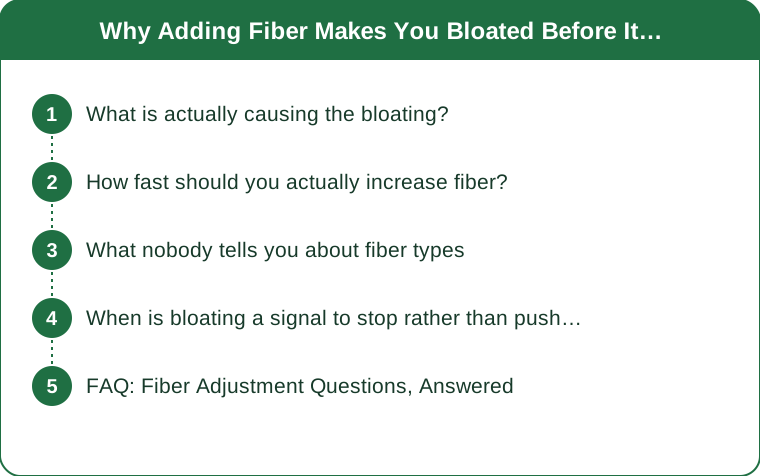
What is actually causing the bloating?
Fermentation, and specifically a mismatch in timing.
Fiber you cannot digest, bacteria can. Soluble and fermentable fibers reach the colon intact and are fermented by resident bacteria, which produces short-chain fatty acids — the beneficial part — and gas, which is the part you feel.
The bacterial population shifts faster than the gas-handling one. Fiber-fermenting species multiply within days of a new substrate arriving. The organisms that consume hydrogen and methane, which reduce net gas volume, take considerably longer to expand. For a week or two you have more production and the same consumption, which is the entire explanation for the bloating window.
Transit time also changes. Higher fiber alters how quickly material moves through, and the gut takes time to recalibrate. During that period, distension and irregularity are common even though the eventual effect is the opposite.
It is genuinely a sign of adaptation rather than intolerance in most cases — although not all, which matters for what to do next.
How fast should you actually increase fiber?
Slower than most advice suggests, and with more attention to type.
About 5g per week is the practical ceiling. If you are eating 15g a day and the target is 30g, that is a three-week ramp rather than a Monday decision. Most people jump 15g overnight and conclude fiber does not suit them.
Spread it across meals rather than loading one. 10g at each of three meals is dramatically better tolerated than 30g in a single large salad, because fermentation load arrives in the colon in a manageable wave rather than a bolus.
Increase fluid at the same time. Fiber without adequate fluid is the classic recipe for the opposite of the intended effect — soluble fiber needs water to form the gel that softens stool. An extra 500ml a day alongside a meaningful fiber increase is a reasonable rule.
Start with the gentler types. Oats, psyllium, cooked carrots, potatoes cooled after cooking, and peeled fruit are far better tolerated than beans, onions, and raw brassicas. Build the base first and add the high-fermentation foods later.

What nobody tells you about fiber types
Not all fiber ferments. Psyllium and cellulose pass through with minimal gas production while still doing the mechanical work. Inulin, fructans, and resistant starch ferment vigorously. If bloating is your limiting factor, the type you choose matters more than the total.
Cooking changes tolerance substantially. Cooked and cooled brassicas produce noticeably less gas than raw ones for most people, and thoroughly cooked pulses are better tolerated than lightly cooked.
Tinned beans, rinsed well, are gentler than dried beans cooked at home. A good deal of the fermentable oligosaccharide leaches into the tin liquid.
The gas usually declines even when the fiber does not. People assume they have to stay at a lower intake permanently. In most cases, the same intake that caused bloating in week one is unremarkable by week six.
Chewing genuinely matters. Larger particles reach the colon with more surface area still available to ferment. It is an unglamorous intervention with a real effect.
And the one that surprises people most: a small amount of gas is not a problem to be eliminated. Fermentation producing short-chain fatty acids is most of the reason fiber is beneficial in the first place.
When is bloating a signal to stop rather than push through?
There is a meaningful line here, and it is worth knowing where it sits.
Adaptation bloating builds over days, peaks within a week or two, is not associated with pain of any severity, does not change your bowel habit dramatically in one direction, and improves steadily.
Signals that suggest something else: significant abdominal pain rather than discomfort; bloating accompanied by diarrhoea that persists; blood in the stool; unintentional weight loss; symptoms that began abruptly rather than in response to a dietary change; or bloating that is worsening at week four rather than improving.
Some people genuinely do not tolerate specific fibers. Fructan sensitivity is common, and someone with IBS may react strongly to onions, wheat, and inulin while tolerating oats and psyllium perfectly well. That is a reason to change the type, not to abandon fiber.
A low FODMAP approach is a diagnostic tool, not a long-term diet. It should be done with a dietitian and reintroduced systematically, because staying on it indefinitely reduces microbial diversity — the opposite of what you were trying to achieve.
This is general information, not medical advice. Persistent or painful symptoms deserve a proper assessment.
FAQ: Fiber Adjustment Questions, Answered
How long until the bloating actually stops?
Typically two to four weeks at a stable intake. If you keep increasing every few days, you keep restarting the clock — which is why the slow ramp is the faster route overall.
Does a fiber supplement cause less bloating than food?
Psyllium usually does, because it ferments minimally. Inulin-based supplements usually cause more, because they ferment readily. The label word ‘fiber’ covers both.
Should I eat fiber at night or in the morning?
Spread it. If you notice bloating most in the evening, weighting intake toward earlier in the day often helps, because you are upright and moving during the peak fermentation window rather than lying down.
TL;DR:
- Bloating comes from gas production outpacing the bacteria that consume it — a timing gap, not a failure.
- Increase by around 5g a week and spread it across meals rather than loading one.
- Add fluid at the same time; fiber without water does the opposite of what you want.
- Choose gentler fibers first — oats, psyllium, cooked and cooled starches — and add high-fermentation foods later.
- Expect it to settle in two to four weeks; worsening at week four, pain, or blood means see someone.
The uncomfortable fortnight is the price of a change that is worth making. Paying it slowly costs less than paying it all at once.
Keep Reading
This article is for general informational purposes only and is not medical advice. Always consult a qualified health professional for guidance specific to you.