Why Your Fiber Intake Quietly Drops in Autumn
Quick Answer: Summer food is incidentally high in fiber - salads, raw vegetables, stone fruit, berries, cold meals built around produce. Autumn eating shifts toward cooked, warmer, more refined, and more convenience-driven food, and the drop can easily be 8-12 grams a day without any conscious change. The symptoms show up about a week later as sluggish digestion, less regularity, and more hunger between meals. The fix is not a supplement - it is three or four specific swaps that put the fiber back where the season took it out.
You did not change your diet. But somewhere around the second week of September, digestion got slower, you got hungrier between meals, and you could not point to anything you were doing differently.
The difference is that in July you were eating a large salad most days, fruit constantly, and vegetables that were raw and abundant.
By late September that has quietly become soup, pasta, toast and something warm - and about ten grams of daily fiber has disappeared without a decision being made.

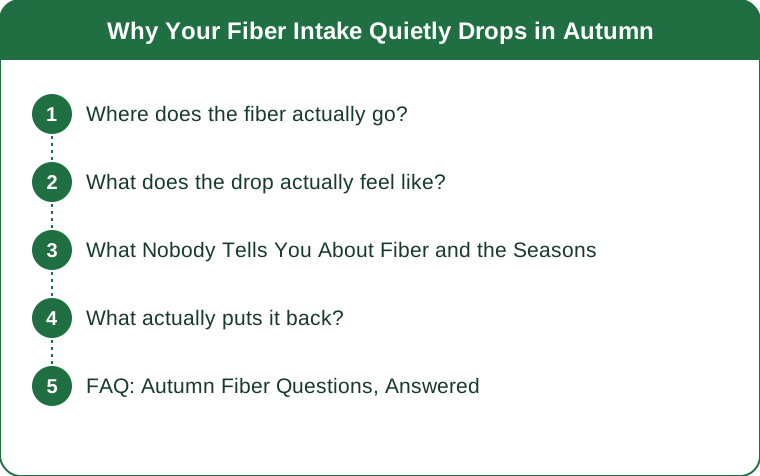
Where does the fiber actually go?
Four shifts happen at once, and none of them feel like a change in how you eat.
Salads become cooked vegetables, and portions shrink. A large summer salad might contain 200-300g of raw vegetables. The cooked equivalent on an autumn plate is frequently 100-150g, because cooked vegetables are a side rather than the base. Cooking does not destroy fiber - the loss is in volume, not in the food. People eat less vegetable by weight when it is cooked, essentially every time.
Fruit intake drops sharply. Summer fruit is grab-and-eat: berries, peaches, plums, melon, grapes. Autumn fruit requires more effort or is simply less appealing cold. For many people this alone is 5-8 grams a day.
Meals get more refined-carbohydrate heavy. Pasta, bread, rice and pastry all increase as the weather cools, and unless they are wholegrain, they contribute very little fiber for a lot of the plate.
Convenience increases with the return of a busy schedule. September restarts work and school routines, and convenience food is consistently lower in fiber than the food it replaces. This is often the largest single factor and the least noticed.
And one more: cold drinks become hot drinks, which sounds irrelevant and is not - people frequently drink less total fluid in autumn, and fiber without adequate water makes constipation worse rather than better.
The arithmetic: most adults are somewhere around 15-20g a day against a recommendation of roughly 30g. Losing 8-10g from a seasonal shift takes an already-low intake to a genuinely low one.
What does the drop actually feel like?
It shows up about a week later, which is why nobody connects it to the cause.
Regularity changes first. Less bulk and less water-holding capacity in the gut means slower transit. This is the most common and most obvious symptom, and it typically appears five to ten days after the dietary shift rather than immediately.
Hunger between meals increases. Fiber contributes substantially to satiety - it slows gastric emptying and blunts the glucose response to a meal. A lower-fiber lunch produces a hungrier 4pm, reliably. A lot of what people experience as an autumn appetite increase is a fiber decrease.
Energy after meals becomes less stable. Fiber slows carbohydrate absorption. Removing it from a meal that is already more carbohydrate-heavy produces a sharper rise and a sharper fall, which is felt as a post-lunch dip.
Gut microbiome changes, more slowly. Fiber is the primary food source for the bacteria that produce short-chain fatty acids, which matter for gut lining health and inflammation. This shifts over weeks rather than days and is not something you feel directly.
And a specific one worth knowing: if you then fix it abruptly - a sudden large increase in fiber to compensate - you will get bloating and gas, because the gut and its bacteria need time to adapt to a change in either direction. Rate of change matters as much as amount, which is why the correction needs to be gradual too.

What Nobody Tells You About Fiber and the Seasons
Cooked vegetables are not lower in fiber than raw ones. Cooking softens the structure, which makes it easier to eat more and easier to digest, but the fiber content per 100g is essentially unchanged. The seasonal loss is entirely about portion size and frequency, not about the cooking.
Some autumn foods are outstanding fiber sources and are underused. Pulses in particular - a cup of cooked lentils is around 15g of fiber, which is close to half a day’s target in one ingredient. Autumn is the natural season for lentils, beans and chickpeas, and they slot into exactly the warm, cooked meals that replace summer salads.
Cooked and cooled starches behave differently. Potatoes, rice and pasta cooked and then cooled form resistant starch, which functions somewhat like fiber - it resists digestion in the small intestine and feeds gut bacteria. A cooled potato salad or leftover rice from the fridge genuinely offers something a freshly cooked portion does not.
Fiber without water makes things worse, not better. This is the most common mistake when people try to correct a drop. Fiber works by holding water; adding it to a low-fluid intake produces harder stool and more discomfort. Increase water alongside fiber, not afterwards.
Skins and peels are a meaningful fraction. Peeling an apple, a potato or a carrot removes a significant portion of its fiber. Autumn cooking involves more peeling than summer eating does, which is a quiet contributor.
And the target is total, not per-meal. Chasing a high-fiber breakfast while eating a low-fiber lunch and dinner is less effective than adding four or five grams to each of three meals. The distribution also matters for comfort - a single very high-fiber meal is more likely to cause bloating than the same amount spread out.
What actually puts it back?
Four swaps, each worth roughly 3-6 grams, applied to the meals that changed.
Swap 1: Add a pulse to one cooked meal a day. A tin of lentils, chickpeas or beans into a soup, stew, curry or pasta sauce. This is by far the highest-return single change - around 6-8g of fiber for something that adds no preparation time and improves the meal.
Swap 2: Wholegrain versions of what you are already eating. Wholegrain bread, wholewheat pasta, brown rice, oats. Each swap is worth roughly 3-5g per serving, and it requires no change in what you cook.
Swap 3: Keep the fruit habit going with autumn fruit. Apples and pears with the skin on, and dried fruit in small amounts. The habit is what disappeared, not the availability - a bowl of apples somewhere visible does most of the work.
Swap 4: Double the vegetable portion in cooked meals, deliberately. This is the direct correction for the volume loss. A cooked vegetable portion should be about the same weight as your summer salad was, which usually means roughly twice what ends up on the plate by default. Frozen vegetables count fully and are the practical answer on a busy evening.
And two supporting habits:
Increase fluid alongside it, especially as hot drinks replace cold ones and total intake tends to fall.
Do it over two to three weeks rather than in one day. A gradual increase gives the gut and its bacteria time to adjust, which is the difference between feeling better and spending a week bloated. This is the single most common reason people conclude that fiber does not agree with them.
On supplements: they work for regularity and they are a reasonable bridge, but whole food fiber brings the vitamins, minerals and polyphenols that a psyllium sachet does not. Food first, supplement if there is still a gap.
FAQ: Autumn Fiber Questions, Answered
How much fiber should I actually be getting?
Roughly 30g a day for adults is the common recommendation, though most people are closer to 15-20g. Rather than tracking precisely, it is more useful to check whether each meal contains a recognisable fiber source - a wholegrain, a pulse, or a decent portion of vegetables or fruit. If two of your three meals have none, that is where the gap is.
Why do I get bloated when I eat more vegetables?
Usually because the increase was too fast. Gut bacteria ferment fiber, producing gas, and the balance of bacteria adjusts over one to two weeks to a new intake level. Increasing by about 5g a week rather than all at once largely avoids this. If bloating is severe, persistent, or comes with pain or changes in bowel habit, that is worth investigating rather than pushing through - it can point to something other than a simple adaptation.
Is it worth taking a fiber supplement instead?
As a bridge, yes - psyllium in particular has good evidence for regularity and for cholesterol. But it is a narrow tool: whole foods bring resistant starch, a range of fiber types, and the micronutrients and polyphenols that the gut microbiome also depends on. Use a supplement to fill a gap, not to replace the food.
General information, not medical advice. Persistent changes in bowel habit, blood in stool, or unexplained weight loss should be assessed by a doctor.
TL;DR:
- Summer eating is incidentally high in fiber. Autumn shifts to cooked, warmer, more refined and more convenient food - easily 8-12g a day lost with no decision made.
- Symptoms appear about a week later: slower digestion, more between-meal hunger, less stable post-meal energy.
- Cooking does not destroy fiber - the loss is portion volume, not the food.
- Four swaps: a pulse in one cooked meal daily (6-8g), wholegrain versions, keep the fruit habit with apples and pears, and double the cooked vegetable portion.
- Increase fluid alongside, and go gradually - about 5g a week. A sudden jump is why people think fiber disagrees with them.
Nothing about your digestion changed. The salad did.
Keep Reading
This article is for general informational purposes only and is not medical advice. Always consult a qualified health professional for guidance specific to you.