Why Cooked Vegetables Are Easier on Your Gut Than Raw at the Same Fiber Count
Quick Answer: Cooking does not remove much fiber - it changes the structure the fiber sits in. Heat breaks down plant cell walls and softens insoluble fiber, so the same 8 grams arrives in your gut in smaller, more accessible pieces that ferment more gradually. Raw vegetables deliver intact cell structure that requires more mechanical breakdown and reaches the colon in a burst. That is why a raw salad and a roasted tray with identical fiber counts produce completely different levels of bloating.
You did everything right. Big salad, plenty of vegetables, exactly the fiber target you were aiming for. Two hours later you are uncomfortable and cannot work out why.

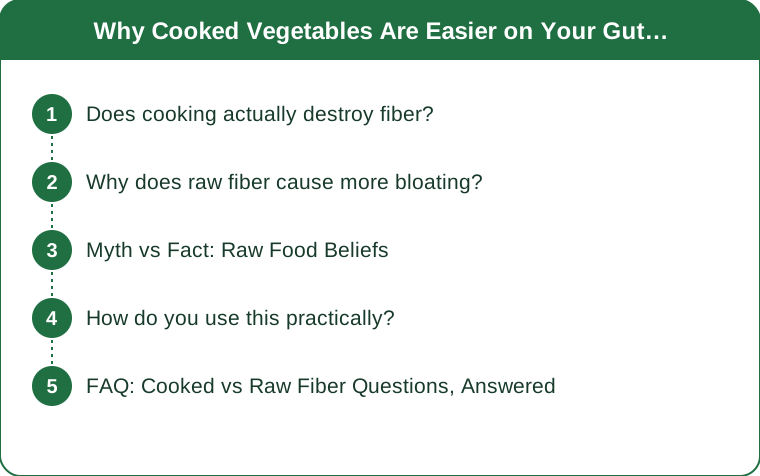
Does cooking actually destroy fiber?
Barely - which is the part that confuses people.
Total fiber content changes very little. Cooking typically alters total dietary fiber by only a few percent in either direction. A cup of raw broccoli and a cup of steamed broccoli have effectively the same fiber on paper.
What changes is the ratio and the physical form. Heat converts some insoluble fiber into more soluble forms and breaks the bonds holding plant cell walls rigid. The grams are the same; the architecture is not.
Cell walls are the real variable. Plant cells are boxes made of cellulose. Cooking softens and ruptures those boxes, which releases the contents and reduces the mechanical work your digestion has to do.
Some nutrients go up, some go down. Water-soluble vitamins decrease with boiling; carotenoids and some antioxidants become substantially more available after heat. Raw is not automatically the more nutritious version, which is worth knowing separately from the digestion question.
And the fiber that remains does its job either way. Both forms feed gut bacteria, both add bulk, both slow glucose absorption. The difference is entirely in how comfortably that happens.
Why does raw fiber cause more bloating?
Three mechanisms, all downstream of intact structure.
More undigested material reaches the colon at once. Intact cell walls resist breakdown in the small intestine, so a larger share of a raw meal arrives in the colon still structured - and arrives together, in a bolus, rather than spread out.
Rapid fermentation produces gas rapidly. Gut bacteria ferment fiber and produce gas as a byproduct, which is normal and desirable. The discomfort is about rate, not amount - the same fermentation spread over four hours is unnoticeable, and compressed into one hour is not.
Chewing rarely finishes the job. Thorough chewing genuinely helps, and almost nobody chews raw vegetables enough to rupture cell walls properly. Cooking does mechanically what forty chews per bite would have done.
Cold food slows gastric emptying slightly for some people. A cold salad sits longer in the stomach than a warm meal, which adds to the sensation of fullness and pressure.
Individual variation is enormous. Gut transit time varies by a factor of three or more between healthy people, and bacterial populations differ hugely. A friend eating identical salads with no issue tells you nothing about your own tolerance.

Myth vs Fact: Raw Food Beliefs
Myth: Raw vegetables are more nutritious. Fact: It depends entirely on the nutrient. Vitamin C and folate decrease with heat; lycopene, beta-carotene, and lutein become far more absorbable. A mixed approach beats either extreme.
Myth: If raw vegetables bloat you, you have a gut problem. Fact: Gas from fermenting fiber is the system working correctly. Discomfort is usually a rate-and-volume issue, not a disorder - though persistent, severe, or painful symptoms are worth a professional conversation.
Myth: Cooking makes vegetables less filling. Fact: Cooked vegetables are often more filling per calorie because you can eat more of them comfortably. A pound of raw spinach is a struggle; a pound cooked is a side dish.
Myth: You should push through and your gut will adapt. Fact: Adaptation is real - the bacterial population does shift over two to four weeks. But pushing through large raw volumes is the least comfortable way to do it, and increasing gradually with cooked vegetables adapts you just as effectively.
Myth: Juicing gives you the fiber benefit more comfortably. Fact: Juicing removes most of the fiber, which is the opposite of the goal. Blending keeps it; juicing does not.
How do you use this practically?
Not by giving up salads - by matching the form to the situation.
Cook the vegetables for high-volume meals. If a meal is meant to deliver a large share of your daily fiber, cooking lets you eat more of it comfortably. Roasting, steaming, and sautéing all work; roasting concentrates flavor and encourages larger portions.
Keep raw for smaller portions and side roles. A side salad alongside a cooked meal is a very different load from a salad as the entire meal.
Split it across the day. The same total fiber spread across three meals is dramatically more comfortable than concentrated in one. This single change fixes more bloating than any food swap.
Time raw vegetables away from workouts. A large raw salad two hours before training is a common and avoidable cause of gut discomfort during exercise. Cooked vegetables clear faster.
Increase water alongside fiber. Fiber without adequate fluid is uncomfortable in both forms, and it is the most common mistake people make when raising intake.
And take advantage of the season. Late summer into autumn is when roasting becomes appealing again - squash, root vegetables, brassicas. The season is quietly pushing you toward the more digestible form, which is convenient if raw salads have been bothering you all summer.
FAQ: Cooked vs Raw Fiber Questions, Answered
Which cooking method preserves the most fiber?
All of them preserve nearly all of it. Steaming and roasting retain more water-soluble vitamins than boiling, so they are the better default - but for fiber specifically, method barely matters.
Does this apply to fruit as well?
Same principle, smaller effect - fruit cell walls are generally softer to begin with. Cooked apples and pears are noticeably gentler than raw for people with sensitive digestion.
Will my tolerance for raw vegetables improve?
Usually yes, over two to four weeks of gradual, consistent exposure. Gut bacteria adapt to what they are regularly fed, and the adaptation is genuine rather than just habituation.
Is bloating after vegetables ever a sign of something serious?
Occasional bloating after a high-fiber meal is normal. Persistent bloating, pain, changes in bowel habits, or symptoms that appear suddenly warrant a conversation with a doctor. This is general information, not medical advice.
TL;DR:
- Cooking removes almost no fiber - it breaks plant cell walls, so the same grams arrive more gradually and ferment more slowly.
- Raw vegetables reach the colon largely intact and in a burst, which is a rate problem, not a quantity problem.
- Cook the high-volume meals, keep raw for smaller side portions, and split total fiber across three meals.
- Raw is not automatically more nutritious - heat increases the availability of several key antioxidants.
If you have been forcing down large raw salads because they seemed like the healthier choice, this is permission to stop. The fiber counts the same either way, and the version you can eat comfortably in real quantity is the one that actually reaches your gut bacteria. Autumn roasting season arrives at exactly the right time.
Keep Reading
This article is for general informational purposes only and is not medical advice. Always consult a qualified health professional for guidance specific to you.