Why Adding Fiber Without Water Makes Everything Worse
Quick Answer: Soluble fiber works by absorbing water and forming a gel, and insoluble fiber works by holding water to add bulk. Both require water to be present. Increase fiber without increasing fluid and you get the opposite of what you wanted - harder, drier stool, more bloating, and more discomfort. The general guidance is roughly 8 ounces of fluid per additional serving of fiber, and considerably more with a concentrated supplement like psyllium.
Most people who report that fiber made things worse have simply not drunk enough alongside it.


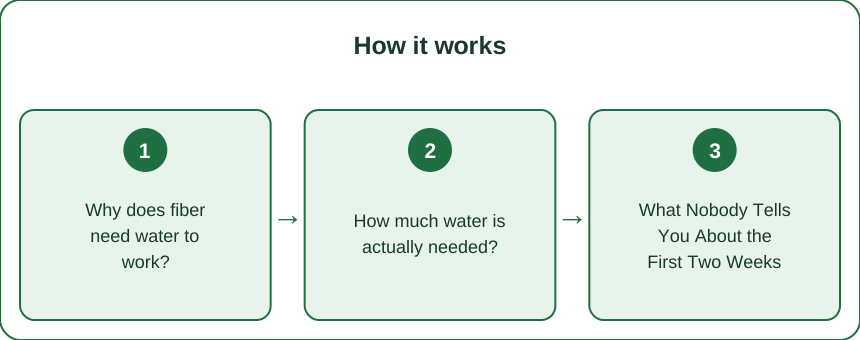
Why does fiber need water to work?
Because water is not an aid to fiber’s mechanism. It is the mechanism.
Soluble fiber - the type in oats, beans, psyllium, apples, and barley - dissolves in water and forms a viscous gel. That gel is what slows gastric emptying, moderates glucose absorption, binds bile acids, and softens stool. Without sufficient water, the gel does not form properly. You have consumed the fiber and not received the effect.
Insoluble fiber - wheat bran, vegetable skins, whole grains - does not dissolve, but it holds water within the stool matrix. That retained water is what increases bulk and softness, which is what stimulates the intestinal wall and speeds transit. Insoluble fiber in a dehydrated gut is essentially adding dry material to something that is already too dry.
So the failure mode is different for each type but the direction is the same. Add fiber without water and:
- Stool gets bulkier but not softer, which is genuinely harder to pass than either bulky-and-soft or small-and-soft.
- Transit slows rather than speeding up.
- Gas and bloating increase, because material is sitting longer in the colon being fermented by gut bacteria.
The uncomfortable irony is that the person most likely to increase fiber - someone dealing with constipation - is often already mildly dehydrated, which is a contributing cause. Adding fiber to that situation without fluid reliably makes it worse, and reliably convinces people that fiber is not for them.
How much water is actually needed?
There are usable numbers here, which is unusual for hydration advice.
For food-based fiber increases, a widely used rule of thumb is an additional 8 ounces of fluid per additional serving of fiber you add. If you go from 15 to 25 grams of fiber a day - roughly three extra servings - that is about 24 additional ounces.
For fiber supplements, considerably more. Psyllium in particular is highly absorbent - it can hold many times its weight in water - and product instructions typically specify at least 8 ounces per dose, taken immediately. This is not a suggestion. Psyllium taken with insufficient liquid can swell in the oesophagus, which is a genuine choking risk and the reason the warning is on the label.
Baseline fluid matters too. General guidance lands around 2.7 litres a day for women and 3.7 for men from all sources including food, and roughly 20 percent typically comes from food. In late-August heat, sweat losses push this up substantially - an active person in hot weather can need noticeably more.
A more practical check than counting ounces: urine colour. Pale straw is the target. Consistently dark yellow while increasing fiber is the specific combination that produces the problem described here.
One detail people miss: timing matters, not just total. Drinking three litres in the evening does not help fiber consumed at breakfast. The water needs to be present when and where the fiber is, which means drinking alongside the fiber-containing meal rather than catching up later.

What Nobody Tells You About the First Two Weeks
The adjustment period is real, it has a predictable shape, and knowing it prevents most people from quitting.
When you increase fiber, the bacterial population in your colon shifts to match the new substrate. That takes time - generally two to four weeks for a meaningful adaptation - and during the transition, fermentation is less efficient and produces more gas.
So the sequence most people experience is:
- Days 1 to 4: noticeable bloating and gas. This is the fermentation adjustment, and it is at its worst here.
- Days 5 to 14: gradually improving, with the bloating becoming intermittent rather than constant.
- Weeks 3 to 4: settled, with the actual benefits becoming apparent.
The two things that make this window worse are increasing too fast and not drinking enough. The recommended pace is roughly 5 grams per week, which feels frustratingly slow and is genuinely worth respecting. Going from 12 grams to 30 in one day produces a memorable few days.
The fiber types also differ in how much gas they produce. Fermentable fibers - inulin, chicory root, the fiber in beans and onions - are the most gas-producing, because they are the most readily used by gut bacteria. Psyllium is relatively low-gas because it is only partially fermented. If bloating is your main obstacle, starting with psyllium or oats rather than an inulin-based supplement is a considerably gentler entry.
One more thing worth naming: some bloating in the first two weeks is a sign it is working, not a sign it is not. The bacteria are being fed. That is the point.
What does getting it right look like day to day?
Concrete and unglamorous, which is why it works.
Pair every fiber addition with fluid at the same meal. Oats at breakfast with a full glass of water alongside, not coffee alone. Beans at lunch with water on the table. This single habit does most of the work.
Front-load fluid across the day. Most people underdrink in the morning and catch up in the evening, which is backwards for both fiber function and sleep.
Increase by about 5 grams a week. One extra serving of something at a time. A serving is roughly: half a cup of beans, one apple with skin, two slices of wholegrain bread, half a cup of oats, or a tablespoon of chia.
Spread it across meals rather than one large hit. 30 grams distributed across three meals is comfortable. 30 grams in one sitting is not, regardless of fluid.
Move. Physical activity independently increases intestinal motility, and a walk after a fiber-heavy meal noticeably helps the transition period.
If you use a supplement, take it with the full stated volume and follow with more. The label amount is a minimum, not a target.
And know when this is not the answer: if constipation persists despite adequate fiber and fluid for several weeks, or if there is pain, blood, or a sudden change in bowel habit, that warrants a doctor rather than more fiber. Some conditions - certain strictures, some IBS presentations, gastroparesis - are made worse by fiber increases, and self-treating through it is not advisable. This is general information, not medical advice.
FAQ: Fiber and Water Questions, Answered
Does coffee count toward fluid?
Yes, largely. The diuretic effect of caffeine at habitual intakes is modest and the net fluid contribution of a coffee is positive. It is not the ideal partner for a psyllium dose specifically, but as part of daily fluid it counts.
Can I get too much fiber?
Yes, though it is uncommon from food alone. Above roughly 50 to 60 grams a day, some people experience impaired absorption of certain minerals and persistent discomfort. The guidance target is around 25 grams for women and 38 for men, and most people are well below rather than above.
Why does psyllium sometimes make me more constipated?
Almost always insufficient water. Psyllium is exceptionally absorbent, and taken with a small amount of liquid it forms a dense mass rather than a soft gel. Take it with a full 8 ounces, then drink another 8 within the following hour, and the picture usually changes completely.
Is soluble or insoluble better for constipation?
Soluble, generally, and this surprises people. Soluble fiber softens by holding water in a gel. Insoluble fiber adds bulk, which helps some people and makes others distinctly worse, particularly if hydration is marginal. If bran made things worse, psyllium or oats are the sensible next thing to try.
TL;DR:
- Water is not an aid to fiber’s mechanism, it is the mechanism - both soluble and insoluble fiber require it to work.
- Add roughly 8 ounces of fluid per extra serving of fiber, and at least a full glass with any psyllium dose, taken immediately.
- Increase by about 5 grams per week; the gut bacteria adaptation takes two to four weeks and gas is worst in the first four days.
- Drink alongside the fiber-containing meal - total daily fluid does not help if the timing is wrong.
- If bran made things worse, try soluble fiber like psyllium or oats rather than more insoluble bulk.
Check urine colour. Pale straw plus rising fiber works; dark yellow plus rising fiber is the combination that backfires. This is general information, not medical advice.
Keep Reading
This article is for general informational purposes only and is not medical advice. Always consult a qualified health professional for guidance specific to you.