Why Adding Fiber Without Adding Water Backfires
Quick Answer: Fiber works by holding water - soluble fiber gels with it, insoluble fiber bulks with it - so raising fiber without raising fluid can leave you more constipated and bloated than before you started. The working formula: increase fiber by about 5 grams per week, add roughly one extra glass of water per 5-gram jump on top of normal hydration, spread fiber across meals instead of front-loading breakfast, and treat psyllium and other supplements as the thirstiest form of all. Give the gut two to four weeks to adapt; the early gas is a transition, not a verdict.
It is one of nutrition’s meaner ironies: the person who finally starts eating more fiber for regularity ends up bloated, gassy, and more backed up than before. The usual conclusion - fiber does not agree with me - is almost always the wrong lesson. The right one is that fiber came alone, and fiber never works alone.

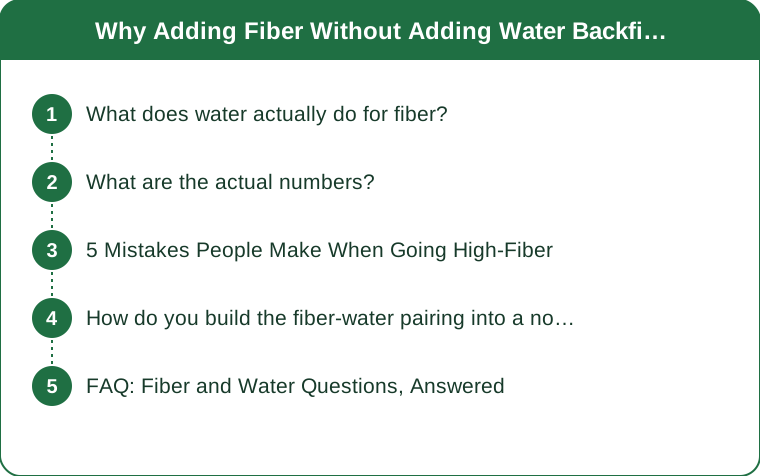
What does water actually do for fiber?
Everything. Fiber is a water-management technology, and running it dry reverses it.
Soluble fiber needs water to become gel. The fiber in oats, beans, apples, chia, and psyllium dissolves and forms a viscous gel - the gel that slows digestion, steadies blood sugar response, feeds gut bacteria, and keeps stool soft and formed. Without enough fluid, that same fiber sits as dense paste: no gel, no glide, and material that moves slower, not faster.
Insoluble fiber needs water to be useful bulk. The structural fiber in wheat bran, vegetable skins, and leafy greens works by adding volume that stretches the colon wall and triggers the muscle contractions that move things along - but only hydrated volume is soft volume. Dry bulk is small, hard, and slow: the mechanism of the paradoxical constipation that hits people who add a big bran habit without a big glass habit.
The colon is a water-reclamation plant, and it does not negotiate. Its job is pulling water back out of waste, and the longer material sits, the drier it gets - a compounding loop where slow gets drier and drier gets slower. Adequate fluid intake keeps the system ahead of the reclamation; inadequate intake plus extra fiber means more material drying out on a slow conveyor.
Even the bacteria care. The fermentation that makes fiber so valuable - the short-chain fatty acid production that gut and metabolic health headlines are built on - proceeds better with well-hydrated material moving at proper speed. A dry, stalled system ferments unevenly, which reads to you as gas pressure and bloating in all the wrong places.
The mental model that makes it stick: fiber is a sponge you swallow. A wet sponge is soft, large, and slippery. A dry sponge is a brick. You choose which one you built with your water glass, not your fork.
What are the actual numbers?
Simple targets, and the schedule matters as much as the totals.
Fiber target: the general guideline is 25 grams a day for women, 38 for men - and the average American lands near 15, which is why the gap-closing project is worth doing at all.
Fluid baseline: around 9 cups (a bit over 2 liters) of total fluid daily for women and 13 for men - and food, coffee, and tea all legitimately count toward it. This is the baseline your body needed anyway.
The pairing rule: for every 5 grams of added daily fiber, add roughly one extra 8-ounce glass of water on top of that baseline. Going from 15 to 25 grams over a few weeks means about two extra glasses a day at the destination. It is not a heroic amount - it just cannot be zero.
The ramp rate: add about 5 grams per week, not per day. The gut microbiome adapts to new fermentation load on a weeks scale; jumping from 15 to 35 grams over a weekend is the classic bloat-and-regret move. Five grams looks like: an apple with skin, a half-cup of beans, two tablespoons of chia, or a switch from white to whole-grain bread.
The distribution rule: spread fiber across the day. Thirty grams at breakfast is a fermentation traffic jam; ten at each meal is a schedule. Distribution also smooths the water demand - a glass with each meal quietly covers most of the pairing rule without any counting.
Supplements are the special case: psyllium and other bulk-forming supplements are concentrated thirst in a scoop, and every label says the same thing for a reason - take with a full glass, minimum. Psyllium taken with a splash of water can gel in the wrong place; taken with real fluid, it is among the best-evidenced regularity tools there is. The label instruction is the entire mechanism in one sentence.

5 Mistakes People Make When Going High-Fiber
1. Doubling intake overnight. The enthusiasm special: fiber cereal, beans at lunch, a giant salad, chia pudding - day one. The microbiome that was running a 15-gram operation gets a 35-gram delivery and ferments it chaotically: gas, bloating, cramping, and an oath never to do that again. The 5-grams-a-week ramp exists because adaptation is real and measured in weeks.
2. Front-loading the whole day at breakfast. Even a reasonable total misbehaves when it lands in one sitting. Spreading fiber across three meals halves the peak fermentation load, feeds bacteria on a steadier schedule, and incidentally works better for fullness and blood sugar steadiness across the day.
3. Taking supplements dry-ish. The psyllium-in-two-sips habit. Bulk-forming supplements without a full glass of water can worsen constipation and, rarely, cause obstruction - which is why the warning is on every label. Full glass with, another glass after, every time, no exceptions.
4. Quitting during the adaptation window. Days three through ten are the noisy phase - the microbiome is literally restructuring around the new supply, and gas is the sound of that construction. Most people who hold steady find it settles substantially by week two to four. Quitting at day five and concluding fiber is not for me is abandoning the renovation the week before it finishes. (Persistent severe pain, blood, or symptoms that worsen past that window are a different story - that is a doctor visit, not a patience test. This is general information, not medical advice.)
5. Counting fiber but not fluid - or fluid but not movement. The triad that makes fiber work is fiber, water, and motion: even a 20-minute daily walk measurably helps colonic transit. The person adding fiber at a desk through a dehydrating August week has changed one dial of three and is grading fiber on the result. Turn all three, then judge.
How do you build the fiber-water pairing into a normal day?
By attaching both to meals you already eat, so no counting survives past week one.
Breakfast: oats or whole-grain toast plus fruit - and the glass of water that lands with the coffee, not instead of it. Chia or ground flax stirred into yogurt is a 4-to-5-gram upgrade that barely registers as effort; both are thirsty seeds, so they ride with the morning glass.
Lunch: the half-cup-of-beans habit - into salads, soups, grain bowls, or quesadillas - is the single highest-yield fiber move in American eating, roughly 6 to 8 grams a pop. Water with lunch is the second glass of the pairing rule, done without thinking.
Afternoon: fruit and a handful of nuts beats the bar with fiber claims - whole-food fiber arrives pre-packaged with its own water content, which is a quiet half-glass of the day’s total. An apple is 86 percent water; the snack hydrates as it bulks.
Dinner: vegetables at their August peak make this the easiest month of the year - tomatoes, corn, zucchini, peppers, melon for dessert. Summer produce is water-rich by nature, which means late-summer fiber is the best-hydrated fiber on the calendar. The seasonal note runs the other way too: August sweat raises your fluid baseline before fiber asks for anything, so the water side of the pairing needs real attention in a heat wave.
The self-check that replaces all tracking: things should be easy, regular, and unremarkable. If output is hard and infrequent, raise water first, fiber second. If gas is loud past week three, slow the ramp and re-spread the meals. And if you want one metric, urine color - pale straw - remains the cheapest hydration gauge ever invented.
When to get help instead of hacking: constipation lasting more than a couple of weeks despite the full triad, pain, blood, or unintended weight change - those are evaluation territory, not more bran. General information, not medical advice.
FAQ: Fiber and Water Questions, Answered
Can fiber make constipation worse?
Yes - when it arrives without enough fluid. Both fiber types work by holding water: soluble fiber gels with it, insoluble fiber becomes soft bulk with it. Dry, they form dense, slow-moving material instead. If more fiber made you more constipated, the usual culprit is the missing water, a too-fast ramp, or both.
How much water should I drink with fiber?
Start from a normal baseline - around 9 cups of total daily fluid for women, 13 for men, food and coffee included - and add roughly one extra glass per 5 grams of added daily fiber. A glass with each meal covers most of it automatically. Supplements like psyllium always get a full glass on their own, per the label.
Why am I bloated after increasing fiber?
Mostly adaptation: your gut bacteria are scaling up to ferment the new supply, and days three through ten are the noisy construction phase. Ramp at about 5 grams per week, spread intake across meals, and pair with fluid - most bloating settles by weeks two to four. Severe, painful, or worsening symptoms past that point deserve a medical look rather than more patience.
Is fiber from food better than supplements?
Food fiber arrives with water content, nutrients, and a mix of fiber types, so it is the better default - and August produce makes it easy. Psyllium and similar supplements are legitimate, well-evidenced tools for closing a stubborn gap, with one non-negotiable: a full glass of water every time, because concentrated fiber is concentrated thirst.
TL;DR:
- Fiber is a sponge: with water it is soft, large, and mobile; without it, a brick. The glass is half the dose.
- Formula: +5 grams of fiber per week, +1 glass of water per 5 grams, spread across meals.
- Supplements are the thirstiest form - full glass with psyllium, always.
- The week-one gas is adaptation, not failure; judge at week three.
- The real triad is fiber, water, movement - turn all three dials before grading any of them.
Fiber never let you down; it just never worked solo. Send the water with it and the whole promise finally shows up.
Keep Reading
This article is for general informational purposes only and is not medical advice. Always consult a qualified health professional for guidance specific to you.