Why Your Digestion Goes Sideways the Week Your Schedule Changes
Quick Answer: Digestion is strongly rhythmic - the gut has its own circadian clock, and colonic activity is highest in the morning and after meals. When your wake time, meal times and bathroom timing all shift within a week, constipation and bloating follow even with unchanged fibre intake. The fixes are consistent meal timing, front-loading fibre earlier in the day, more fluid than feels necessary, and protecting the morning window rather than rushing through it.
Adding more fibre without adding fluid during a schedule change reliably makes it worse, which is the mistake most people make first.
This is general information rather than medical advice.


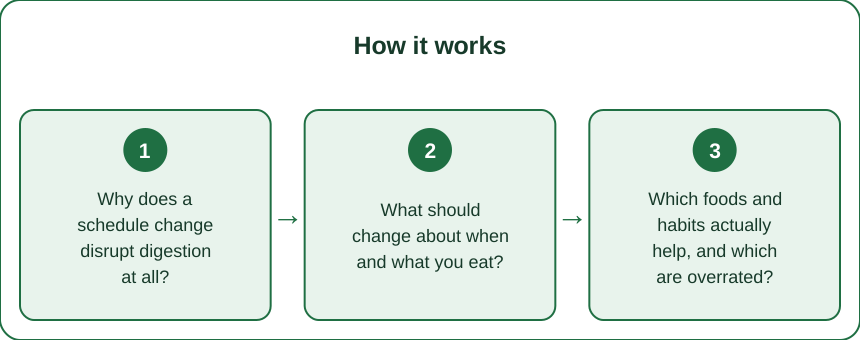
Why does a schedule change disrupt digestion at all?
Because the gut runs on a clock, and you have just moved every input that sets it.
The gut has its own circadian rhythm. Gastrointestinal motility, digestive enzyme secretion and the composition of gut bacteria all follow daily patterns. Colonic motor activity is highest in the morning after waking and after meals - the two events that a schedule change moves.
The gastrocolic reflex. Eating triggers colonic contractions, and this reflex is strongest in the morning and after the largest meal of the day. A predictable breakfast at a predictable time produces a predictable urge, which is the whole basis of a stable routine.
What a schedule change does to it:
- Wake time moves, so the morning motility peak arrives at a different clock time
- Breakfast is rushed, eaten in a car, or skipped, which removes or weakens the strongest daily trigger
- The morning bathroom window disappears, because there is no longer twenty unhurried minutes in it
- The largest meal shifts later, moving the strongest gastrocolic response to the evening
The suppression problem, which is the biggest single factor. When the urge arrives during a school run or a commute, it gets suppressed. Repeated suppression reduces rectal sensitivity over days to weeks, which means the signal itself gets weaker - and that is the mechanism behind schedule-change constipation.
Why more fibre alone does not fix it. The problem is timing and transit, not volume. Adding fibre to a system with slowed transit and inadequate fluid produces bloating and harder stool, which is precisely the opposite of the intent.
What should change about when and what you eat?
Protect the morning, front-load fibre, and increase fluid before increasing fibre.
Protect the morning window, which is the highest-value change.
- Wake 15 to 20 minutes earlier than the schedule strictly requires. That margin is what makes the rest possible
- Eat something within an hour of waking, even small. The gastrocolic reflex needs food to trigger it and the morning is when it is strongest
- A warm drink on waking produces a measurable effect for many people
- Do not suppress the urge. This is the single most important behavioural point, and it is why the 20-minute margin matters
Front-load fibre into the earlier part of the day.
- Fibre eaten in the morning has the whole day of activity and motility to move through, whereas fibre eaten at 9pm sits through the overnight slowdown
- A target of 25 to 30g daily for adults, with most people currently getting around half of that
- Aim for 8 to 12g at breakfast, which is achievable with oats, berries and seeds
Fluid before fibre, always.
- Soluble fibre absorbs water to form a gel. Without adequate fluid, it makes stool harder, not softer - the opposite of the intended effect
- Around 2 litres a day for most adults, more in late summer heat and more if fibre is increasing
- This is the most common reason a fibre increase backfires, and it is entirely avoidable
Increase fibre slowly if you are increasing it.
- 3 to 5g additional per week, not a jump
- The gut microbiome adapts to a new fibre load over one to two weeks. A sudden increase produces gas and bloating for the same reason a sudden increase in anything does
- During a schedule transition, hold fibre steady and fix timing first. One variable at a time

Which foods and habits actually help, and which are overrated?
A short list works well and a longer list of popular options does very little.
Genuinely effective:
- Kiwifruit. Two a day has good trial evidence for constipation, comparable to some standard interventions. Underused and easy
- Prunes. Around 50g daily has repeatedly outperformed psyllium in trials. The effect combines fibre and sorbitol
- Oats and other soluble fibre, which soften stool and are well tolerated
- Psyllium husk, which is the best-evidenced fibre supplement - but only with substantial fluid
- Movement. Even a 10 to 15 minute walk after meals increases motility measurably. This is the most underrated item on the list and it fits into a school-run schedule easily
- Magnesium-rich foods, and for some people supplemental magnesium, though that is worth discussing with a pharmacist
Helpful but secondary:
- Fermented foods, which support the microbiome but do not reliably fix acute constipation
- Coffee, which stimulates colonic activity in many people. Useful as a timing anchor rather than as a treatment
- Warm liquids on waking, effective for some and not others
Overrated:
- Fibre supplements without fluid, which are actively counterproductive
- Most probiotic supplements for constipation, where the evidence is strain-specific and much weaker than marketing suggests
- Detox teas, most of which contain senna - a stimulant laxative that should not be used regularly and which produces dependence with repeated use
- Simply eating more of everything, which increases volume without addressing transit
A note on late summer heat. Fluid needs are higher, and mild dehydration is one of the most common contributors to constipation in hot weather. A schedule change happening during a heatwave stacks two causes at once, which is exactly the situation late August produces.
What Nobody Tells You About Gut Routines
Consistency of timing matters more than the content of any single meal. People overhaul what they eat and change nothing about when. The gut’s circadian rhythm responds to regular meal timing, and eating similar amounts at similar times does more for regularity than any specific food.
Suppressing the urge has a measurable cost. Repeatedly ignoring the signal reduces rectal sensitivity over days to weeks. This is why the school-run fortnight can produce constipation that outlasts the schedule change itself, and it is entirely a behavioural cause with a behavioural fix.
Travel and schedule changes affect the microbiome, not just motility. Gut bacterial composition shifts with meal timing, and the shift takes days to settle - which is part of why the first week of any new routine feels different regardless of what you eat.
Position matters more than people expect. A footstool that raises the knees above the hips changes the anorectal angle and reduces straining measurably. It is a cheap intervention with surprisingly good evidence.
Stress alone changes transit in both directions. The gut-brain axis is bidirectional, and the stress of a schedule change is itself a cause, separate from the timing effects. This is why the same disruption gives some people constipation and others the opposite.
It usually resolves in one to two weeks on its own. Most schedule-related disruption settles as the routine stabilises. The reason to intervene is to shorten it, not because it is likely to be permanent - and knowing that stops people escalating to laxatives in week one.
FAQ: Digestion and Schedule Changes, Answered
Why am I constipated when I have not changed what I eat?
Because gut motility follows a daily rhythm set by wake time and meal times. Moving both, and losing the unhurried morning window, disrupts transit even with identical food.
Should I just add more fibre?
Not first, and never without more fluid. Adding fibre to slowed transit without adequate water makes stool harder. Fix timing and fluid before touching fibre.
How much fibre and fluid should I aim for?
Around 25 to 30g of fibre daily for adults and roughly 2 litres of fluid, more in hot weather. Increase fibre by 3 to 5g per week rather than all at once.
What is the single most effective food?
Kiwifruit and prunes both have good trial evidence - two kiwifruit or about 50g of prunes daily. Prunes have outperformed psyllium in several trials.
Does exercise really help?
Yes. A 10 to 15 minute walk after meals increases motility measurably and is one of the easiest things to fit into a compressed schedule.
When should I see a doctor?
Constipation lasting more than three weeks despite these changes, blood in stool, unexplained weight loss, persistent abdominal pain, or a marked change in bowel habit over 50. Those warrant assessment rather than self-management.
TL;DR:
- The gut runs on a circadian rhythm set by wake time and meal times, so a schedule change disrupts it directly
- Protect a 20-minute unhurried morning window - suppressing the urge reduces the signal over days
- Increase fluid before increasing fibre, or the fibre makes things harder rather than softer
- Front-load fibre into breakfast, where the day’s motility can act on it
- Kiwifruit, prunes and a short post-meal walk are the highest-value interventions
Most schedule-related disruption settles within a fortnight. What you do in that fortnight decides whether it settles or becomes the new normal.
Keep Reading
This article is for general informational purposes only and is not medical advice. Always consult a qualified health professional for guidance specific to you.