Fiber Supplement vs. Whole-Food Fiber: Which One Actually Works Better?
Quick Answer: Whole-food fiber sources generally provide broader benefits — including a mix of soluble and insoluble fiber, plus vitamins, minerals, and beneficial plant compounds that supplements don’t replicate — while fiber supplements are most useful as a convenient bridge for specific gaps, not a full substitute for dietary fiber sources.
Fiber supplements are marketed as an easy fix, and they do solve part of the problem. But ‘part of the problem’ is the key phrase most marketing leaves out.

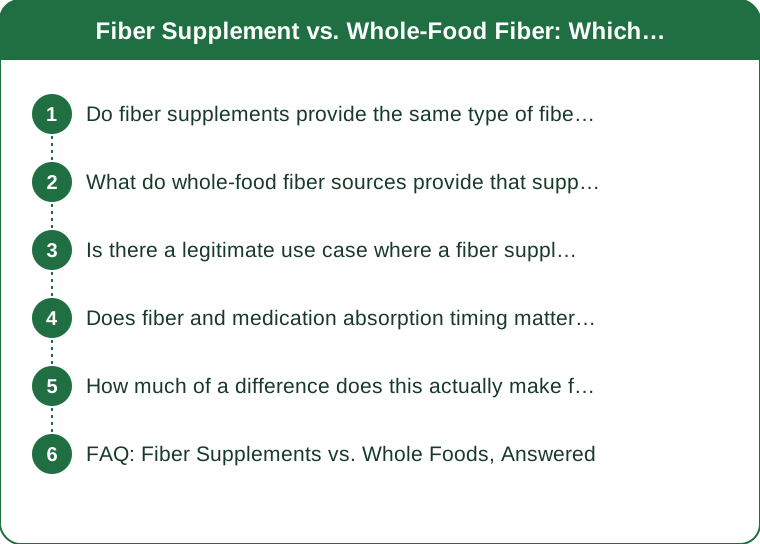
Do fiber supplements provide the same type of fiber as food?
Not always — most fiber supplements provide primarily one type of fiber (commonly a soluble fiber like psyllium or inulin), while whole foods like beans, vegetables, and whole grains naturally provide a mix of soluble and insoluble fiber that supports different digestive functions. Relying solely on a single-type supplement misses part of fiber’s full range of benefits.
What do whole-food fiber sources provide that supplements don’t?
Whole foods deliver fiber alongside vitamins, minerals, antioxidants, and other beneficial plant compounds that work together with fiber in ways not yet fully replicated by isolated supplements. This combined effect, sometimes called a food synergy effect, is a meaningful part of why nutrition research consistently favors whole-food sources over isolated supplement equivalents.
Is there a legitimate use case where a fiber supplement makes sense?
Yes — supplements can be genuinely useful for closing a specific, measured gap when whole-food intake consistently falls short, or during a temporary period when dietary variety is limited. They’re a practical bridge tool, not a preferred long-term replacement for dietary sources when those sources are realistically accessible.

Does fiber and medication absorption timing matter more with supplements?
Yes, this is an important practical consideration — concentrated fiber supplements taken close to medication doses can interfere with absorption more noticeably than the same fiber amount spread across meals from whole foods, since supplements deliver a larger fiber dose in one sitting. Spacing supplement fiber at least a couple hours from medications is a commonly recommended precaution.
How much of a difference does this actually make for digestive health specifically?
For general digestive regularity, both sources can be effective, but the broader mix of fiber types and accompanying nutrients in whole foods tends to support a more diverse gut microbiome, which has downstream effects on digestive health beyond just stool regularity that a single-type supplement doesn’t fully replicate.
FAQ: Fiber Supplements vs. Whole Foods, Answered
Is it fine to use a fiber supplement daily long-term?
Generally safe for most people, but it’s worth periodically reassessing whether whole-food sources could realistically fill the same gap instead.
Can fiber supplements cause more bloating than food sources?
Some people report more bloating with concentrated supplements due to the fiber dose being consumed quickly, versus fiber from food being spread across a meal.
Should fiber supplements be taken with or without food?
Most are fine either way, but taking with adequate water intake is important regardless, since insufficient water with concentrated fiber can worsen digestive discomfort.
TL;DR:
- Whole foods provide a broader mix of fiber types than most single-type supplements
- Vitamins, minerals, and plant compounds in whole foods work alongside fiber in ways supplements don’t replicate
- Supplements are a legitimate bridge tool for specific gaps, not a full substitute
- Concentrated supplement fiber needs more careful spacing from medications than food-based fiber
A fiber supplement can fill a real gap, but it’s not a one-to-one substitute for the broader benefits whole-food fiber sources provide.
Keep Reading
This article is for general informational purposes only and is not medical advice. Always consult a qualified health professional for guidance specific to you.