Why Your Usual Fiber Intake Suddenly Causes Bloating on Heavy Training Weeks
Quick Answer: Intense exercise temporarily reduces blood flow to the digestive system and can slow gut motility in the hours immediately after training, which lowers your fiber tolerance on heavy training days compared to lighter ones. Shifting fiber-heavy meals away from the immediate post-workout window, rather than cutting fiber overall, usually resolves the bloating.
You haven’t changed your diet at all, but a harder training block suddenly has you dealing with bloating you didn’t have a month ago on the exact same fiber intake. The fiber didn’t become a problem — your digestive system’s capacity to handle it shifted along with your training load.

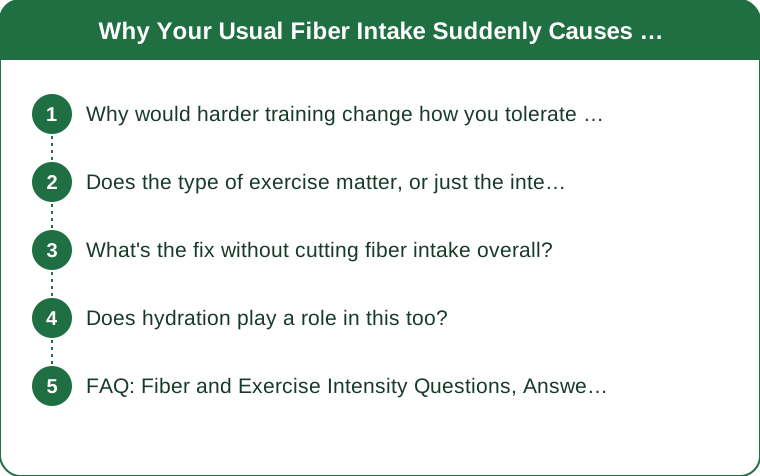
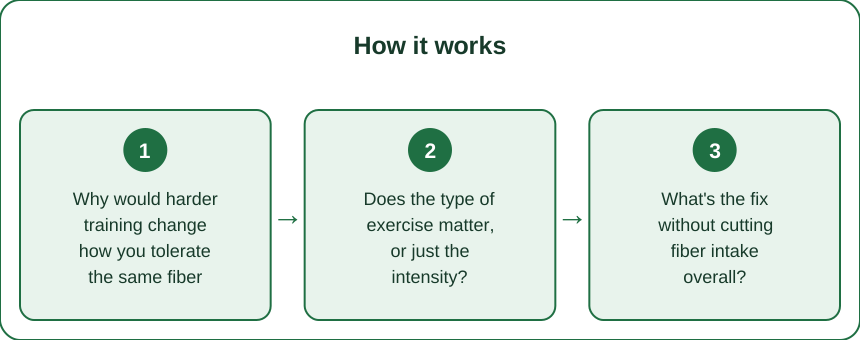
Why would harder training change how you tolerate the same fiber intake?
During intense exercise, blood flow is redirected away from the digestive system toward working muscles, and this effect can linger for a period after training ends, temporarily slowing gut motility and digestive efficiency. Fiber, which already requires more digestive work than simpler carbohydrates, becomes harder to process well during this window specifically.
This is a temporary, exercise-linked shift, not a sign your baseline fiber tolerance has permanently changed — it’s specific to the physiological state your body is in during and shortly after hard training.
Does the type of exercise matter, or just the intensity?
Intensity and duration both matter more than exercise type specifically — longer or higher-intensity sessions (hard intervals, long runs, heavy lifting blocks) divert more digestive blood flow for longer than a moderate, steady-state session does. Lighter training days generally don’t produce the same fiber-tolerance dip.
This is why the same fiber intake might feel completely fine on an easy training week and cause noticeable discomfort during a hard block, even without any change to what or how much fiber you’re eating.

What’s the fix without cutting fiber intake overall?
Shift fiber-heavy meals away from the 1-2 hours immediately before and after intense training, when digestive blood flow is most redirected, rather than reducing total daily fiber. A high-fiber breakfast several hours before a hard afternoon session, for example, gives your digestive system time to process it before training redirects blood flow away from the gut.
Splitting fiber intake across more, smaller servings through the day — rather than one large fiber-heavy meal — also reduces the digestive load at any single point, which helps during heavier training blocks specifically.
Does hydration play a role in this too?
Yes, significantly — fiber requires adequate water intake to move through the digestive system smoothly, and heavier training increases fluid needs through sweat loss. If hydration doesn’t increase alongside training volume, the same fiber intake becomes more likely to cause bloating and discomfort simply due to insufficient water to process it properly.
Tracking whether bloating coincides with days you also fell short on fluids is worth doing before assuming fiber itself is the sole variable — often the two issues compound each other.
FAQ: Fiber and Exercise Intensity Questions, Answered
Should I cut fiber entirely during a heavy training block?
Not necessary for most people — timing fiber away from the immediate pre/post-workout window usually resolves the issue without needing to reduce overall intake.
How long does the reduced digestive blood flow effect actually last after a hard session?
It varies by individual and session intensity, but effects are typically most noticeable in the first 1-2 hours post-exercise and diminish substantially after that window.
Does this affect soluble and insoluble fiber differently?
Insoluble fiber (found in whole grains, some vegetables) tends to be more likely to cause bloating during this window since it adds more bulk requiring digestive work, while soluble fiber is generally gentler during periods of reduced gut motility.
TL;DR:
- Intense training redirects blood flow away from digestion, temporarily lowering fiber tolerance
- Longer, harder sessions cause a bigger dip than easy training days
- Time fiber-heavy meals away from the 1-2 hours around hard training rather than cutting fiber overall
- Hydration needs rise with training volume too — insufficient fluids compound fiber-related bloating
Keep Reading
This article is for general informational purposes only and is not medical advice. Always consult a qualified health professional for guidance specific to you.