Why Travel Wrecks Your Digestion, and What Fiber Can Actually Fix
Quick Answer: Travel constipation is usually caused by three things at once - less movement, less water, and a disrupted routine - and fiber only helps if the first two are addressed. Adding fiber without adequate fluid actually makes things worse. The reliable sequence is water first, movement second, then keep your normal fiber intake steady rather than spiking it. A sudden fiber increase on day two of a trip is the most common way people make an uncomfortable situation genuinely miserable.
The instinct to fix travel digestion by loading up on fiber is understandable and it is backwards.

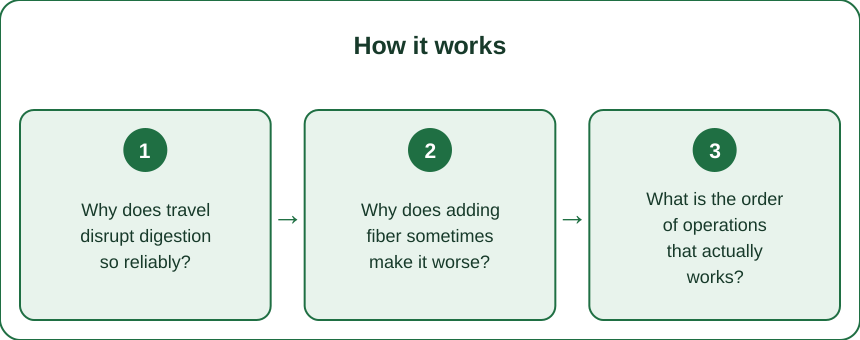
Why does travel disrupt digestion so reliably?
Four mechanisms, and they arrive together.
Reduced movement. Physical activity stimulates the movement of contents through the colon. A travel day replaces a normal amount of walking with hours of sitting, and the effect is direct rather than subtle.
Dehydration. People drink less while traveling - less convenient access, deliberate restriction before flights, dry cabin air, and more caffeine and alcohol. The colon absorbs water from stool, so less available fluid means harder, slower transit.
Routine disruption. The gut has its own circadian rhythm, partly entrained by meal timing. Time zone changes, irregular meals and skipped breakfasts all disturb it. There is also the practical matter that many people simply do not want to use unfamiliar bathrooms, and repeatedly ignoring the urge reduces the signal over a few days.
Diet change. A trip usually means less fiber than usual - fewer vegetables, more refined carbohydrates, restaurant food.
Notice that only one of these is about fiber. Which is why fiber alone rarely resolves it.
Why does adding fiber sometimes make it worse?
Because most fiber works by absorbing water, and if the water is not there, the mechanism runs backwards.
Soluble fiber forms a gel with water. Psyllium is the clearest example - it absorbs many times its weight in fluid to create a soft, bulky mass that moves easily. Taken with insufficient fluid, it forms a dense mass that is harder to pass, not easier.
Insoluble fiber adds bulk and stimulates transit, which helps when things are moving and adds volume to a system that is already backed up when they are not.
A sudden increase also produces gas. Gut bacteria ferment fiber, and a rapid change in intake gives them more substrate than the population is adapted to. Bloating and cramping on day three of a trip is very often a self-inflicted fiber spike.
The rule: keep fiber roughly at your normal level while traveling, increase fluid substantially, and only increase fiber gradually and with plenty of water if you increase it at all.

What is the order of operations that actually works?
First: water. Aim to drink noticeably more than feels necessary, particularly on flight days. A useful check is urine color rather than a fixed volume target.
Second: movement. A 20 to 30 minute walk in the morning is more effective than most people expect - moderate activity has a measurable effect on colonic transit. On a travel day, walking the terminal counts.
Third: protect one routine anchor. Eat breakfast at roughly your usual body-clock time and allow unhurried time after it. The gastrocolic reflex - the increase in colonic activity after eating - is strongest in the morning and after the first meal, and rushing past it is the most commonly missed factor.
Fourth: keep fiber steady. Fruit at breakfast, a vegetable at dinner, whole grains where available. Steady, not spiked.
Fifth, if needed: magnesium. Magnesium citrate draws water into the intestine and works differently from fiber - useful when fiber is not the missing input. Start with a modest dose.
The single highest-value habit: a large glass of water and a 15-minute walk immediately after breakfast, every day of the trip.
Myth vs Fact: fiber, travel and digestion
Myth: More fiber always helps constipation. Fact: in cases driven by slow transit and low fluid, increasing fiber can worsen bloating and discomfort. Fiber helps most when low intake is actually the cause - which on a trip it often is not.
Myth: Coffee is dehydrating enough to make it worse. Fact: moderate coffee contributes to daily fluid intake, and its stimulating effect on the colon is genuinely useful. Keeping your usual morning coffee is helpful, not harmful.
Myth: You should hold out until you get home. Fact: three or four days of ignored urges reduces rectal sensitivity and makes the problem persist past the trip. Use the bathroom when you get the signal, however inconvenient.
Myth: Prunes are folklore. Fact: prunes have reasonable evidence behind them - both fiber and sorbitol contribute, and studies have found them effective for mild constipation. They travel well, which is unusual among things that work.
Myth: It will resolve on its own in a day or two. Fact: it often does, and the version that does not is usually the one where nothing about water, movement or routine changed. The interventions are easy enough that waiting is rarely the better choice.
FAQ: Travel Digestion Questions, Answered
How much water is enough while traveling?
More than at home, particularly on flight days, since cabin air is very dry. Rather than a fixed number, use pale-yellow urine as the practical indicator and drink an extra glass with every meal.
Should I bring a fiber supplement on trips?
Only if you already take one regularly. Starting psyllium mid-trip without a well-established fluid habit is the classic way to trade constipation for bloating. If you do take it, take it with a full large glass of water, not a sip.
How long before travel constipation is worth worrying about?
A few days of disruption during travel is common and resolves once you are home and back to routine. Constipation lasting more than a week, or accompanied by significant pain, blood or vomiting, should be discussed with a healthcare professional.
Does a time zone change matter, or is it just the sitting?
Both. The gut has its own clock partly set by meal timing, and crossing several time zones desynchronizes it for a few days. Eating meals on local time from day one speeds the adjustment.
This is general information, not medical advice.
TL;DR:
- Travel constipation comes from reduced movement, dehydration, routine disruption and diet change - only one of those is about fiber.
- Adding fiber without adequate fluid makes it worse, because most fiber works by absorbing water.
- The order is water, then movement, then protecting an unhurried breakfast, then keeping fiber steady.
- Magnesium citrate works by a different mechanism and is a reasonable option when fiber is not the missing input.
- A big glass of water and a 15-minute walk after breakfast is the single most effective daily habit.
Most of this resolves faster than people expect once the water and the walk are in place. The trap is reaching for a fiber supplement first and spending day four bloated in addition to everything else.
Keep Reading
This article is for general informational purposes only and is not medical advice. Always consult a qualified health professional for guidance specific to you.