Why Taking Fiber Supplements Right Before Your Meds Can Quietly Undo Both
Quick Answer: Fiber supplements can bind to certain medications in the gut and reduce how much gets absorbed, particularly with thyroid medication, some antidepressants, and certain heart medications. The standard guidance is to separate fiber supplements from medications by at least 2-4 hours, and to keep the gap consistent day to day rather than random.
A fiber supplement added to “help with regularity” seems harmless enough that most people don’t think to time it around their prescriptions — but the same binding property that makes fiber useful for digestion is exactly what can interfere with drug absorption when they’re taken together.

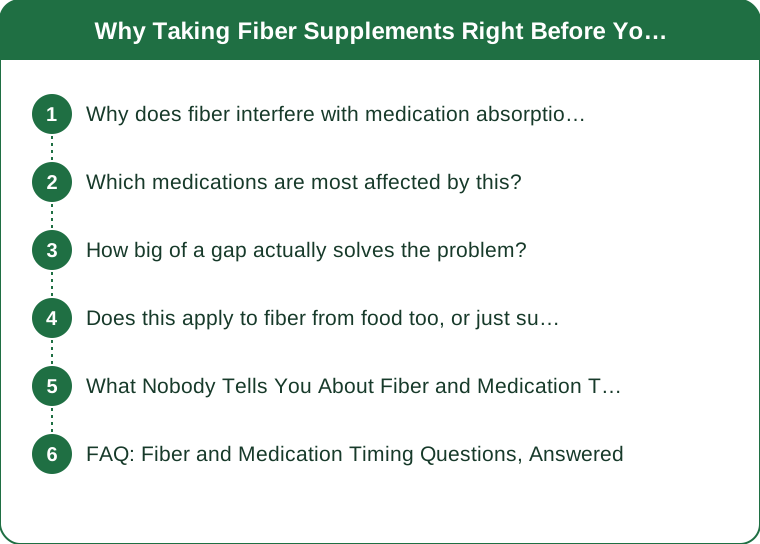
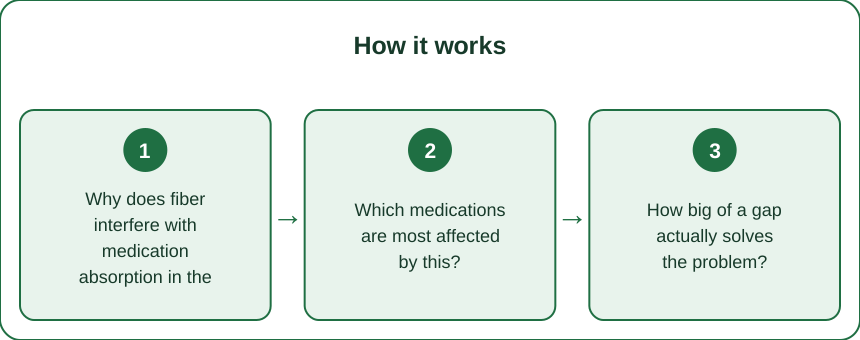
Why does fiber interfere with medication absorption in the first place?
Soluble fiber forms a gel-like substance in the gut that can physically bind to certain drug compounds, particularly ones that rely on being freely dissolved and absorbed through the intestinal wall — the fiber essentially traps some of the medication before it can be absorbed, reducing the effective dose that reaches your bloodstream.
Which medications are most affected by this?
Thyroid medication (levothyroxine) is one of the most commonly flagged, since even small absorption reductions can meaningfully affect thyroid hormone levels over time. Certain antidepressants and some heart medications (digoxin among them) also appear on interaction lists, which is why pharmacists often ask about supplement timing specifically for these prescriptions.
How big of a gap actually solves the problem?
A 2-4 hour separation between fiber supplement and medication is the standard guidance across most sources — taking your medication first thing in the morning and your fiber supplement at lunch, for example, keeps enough distance that binding interference becomes minimal.

Does this apply to fiber from food too, or just supplements?
The effect is generally smaller with fiber from whole foods since it’s less concentrated and absorbed more gradually than a supplement dose, but the same principle holds at a smaller scale — a very high-fiber meal taken at the exact same time as a sensitive medication isn’t ideal either.
What Nobody Tells You About Fiber and Medication Timing
Consistency matters as much as the gap itself — a medication like levothyroxine is dosed based on stable absorption, so randomly varying the fiber-to-medication gap day to day (sometimes 1 hour, sometimes 5) can cause more fluctuation in effective dose than sticking with a shorter but consistent gap.
This interaction is often missed because it develops slowly — a thyroid level drifting slightly off over months from inconsistent fiber timing looks like a dosing issue on labs, not a supplement-timing issue, unless someone specifically asks about supplement habits.
Pharmacists flag this far more than general practitioners bring it up unprompted — asking your pharmacist directly when starting a new fiber supplement is the fastest way to get medication-specific timing guidance.
FAQ: Fiber and Medication Timing Questions, Answered
How do I know if my specific medication is affected?
Ask your pharmacist directly when you pick up the prescription or start a new fiber supplement — they can check your specific medication against known interaction lists quickly.
Does psyllium husk behave differently from other fiber supplements here?
Psyllium is actually one of the more commonly flagged fibers for this interaction specifically because of how effectively it gels, so the same 2-4 hour spacing guidance applies, if not more so.
Is it safer to just take fiber and medication in the same daily routine, back to back?
No — that’s actually the pattern most likely to cause absorption interference; spacing them apart is the safer approach.
This is general information, not medical advice — check your specific medications with a pharmacist or doctor.
TL;DR:
- Fiber’s gel-forming property can bind medications in the gut and reduce absorption
- Thyroid medication, some antidepressants, and certain heart medications are the most commonly flagged
- A 2-4 hour gap between fiber supplement and medication is standard guidance
- Consistency in the gap matters as much as the length of the gap itself
It’s a small scheduling habit, but it’s the kind of thing that quietly protects both the fiber’s benefit and the medication’s effectiveness.
Keep Reading
This article is for general informational purposes only and is not medical advice. Always consult a qualified health professional for guidance specific to you.