Why More Fiber Without More Water Backfires Completely
Quick Answer: Fiber absorbs water as it moves through your gut — without enough fluid, it can harden and worsen constipation instead of relieving it. Add roughly 1-1.5 extra cups of water for every 5g of fiber you add, spread through the day.
You did everything right: swapped white bread for whole grain, added beans to lunch, started a fiber supplement. And somehow you feel more bloated and backed up than before. This is the most common fiber mistake, and it has nothing to do with the fiber itself.

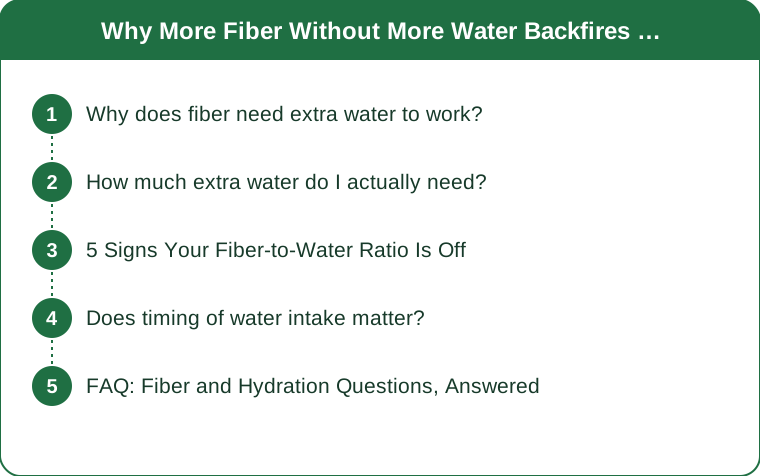
Why does fiber need extra water to work?
Soluble fiber forms a gel with water as it passes through your gut, which is what makes stool soft and easy to move. Insoluble fiber adds bulk, but that bulk needs moisture to stay pliable rather than dense and hard.
Without enough fluid, both types of fiber can do the opposite of their job — insoluble fiber especially can compact into a hard mass that’s genuinely harder to pass than before you added it. This is the single most common reason fiber increases backfire.
How much extra water do I actually need?
A practical rule: for every 5 grams of fiber you add to your usual intake, add roughly 1 to 1.5 extra cups (240-360ml) of water, spread across the day rather than chugged at once.
So if you jump from 15g to 30g of daily fiber, that’s an extra 3-4.5 cups of water on top of your baseline. Most adults need 8-10 cups total daily as a starting reference, more with exercise or heat.

5 Signs Your Fiber-to-Water Ratio Is Off
1. New bloating that wasn’t there before. Usually means water isn’t keeping pace with fiber intake.
2. Harder, not softer, stools. The opposite of fiber’s intended effect — a clear hydration flag.
3. Feeling unusually full or heavy after meals. Fiber without enough water sits denser in the gut.
4. Increased gas within the first week. Some is normal adjustment; persistent gas past 2 weeks often means insufficient fluid.
5. Thirst that spikes right after high-fiber meals. Your body is telling you directly — listen to it.
Does timing of water intake matter?
Somewhat — drinking a full glass of water with a high-fiber meal (not just around it) helps fiber hydrate as it enters the gut rather than absorbing water later from your system, which can leave you dehydrated elsewhere.
Spacing water evenly through the day beats front-loading it in the morning — your gut processes fiber continuously, so hydration support should be continuous too.
FAQ: Fiber and Hydration Questions, Answered
Can I drink too much water when increasing fiber?
It’s uncommon but possible with extreme intake. For most people adding a normal 10-15g of fiber, an extra 2-3 cups of water is well within safe range.
Does coffee or tea count toward my fiber-water needs?
Mildly, but caffeinated drinks have a mild diuretic effect that partially offsets their hydration value — don’t count them as your main source when fiber intake goes up.
How fast should I see improvement after fixing water intake?
Most people notice easier, more comfortable digestion within 3-5 days of matching water to their new fiber level.
TL;DR:
- Fiber needs water to do its job — without it, symptoms can get worse, not better
- Add roughly 1-1.5 cups of water per extra 5g of fiber, spread through the day
- New bloating or harder stools after adding fiber is almost always a hydration signal
- Drink water with high-fiber meals, not just around them
Before you blame the fiber, check the water — it’s the fix that takes zero extra planning.
Keep Reading
This article is for general informational purposes only and is not medical advice. Always consult a qualified health professional for guidance specific to you.